Wednesday, 17 December 2014

Group Planning

Group Planning

Firstly, my group is made up of three members; myself, Jemimah and Rishika. Within our lesson time we have partaken in many discussions and meetings, based around the planning and production of our thriller film. These meetings are crucial in terms of exploring each members ideas and discussing the strengths and weaknesses, until we come to a unanimous decision. The process of analytically reviewing each element of the film with my group members allowed me to explore many thoughts and ideas I had not considered initially. 

The first of our group meetings took place on the 17th October and the main topic of discussion was, creating a narrative for our future thriller film. Within the group we presented individually, our narrative and looked at each one, picking out the positive and more negative responses the narrative provides. Although we could have used our first meeting to create a narrative as a group, not focusing on our individual ideas, this would not be as effective as our approach. By coming to our meeting, with an idea of our own, this meant that each group member displayed an even amount of participation, towards the initial stages of creating our thriller sequence, not simply rewording an idea someone in the group has thought long and hard about. Once we had out weighed each pro and con of each idea we concluded that we would follow Jemimah's narrative. Our reason behind this decision was that it followed a variety of highly conventionally features of a thriller film and therefore made it very easy to work with, as we could easily apply the different elements, such as cinematography, lighting, sound etc, to other famous thriller films. In turn, this would provide us with a vast quantity of inspiration, we could then later apply to our film. 

mise-en-scene planning 
The next topic of discussion was, mise-en-scene. As displayed in the image on the left, on the 4th November, we created a visual resource, an elaboration of each element within mise-en-scene, in regards to our narrative specifically. I found it extremely helpful to present our ideas in a clear and divided manner such as this. It allowed me to not become over whelmed by the vast quality of sections associated with mise-en-scene, as I could clearly view them and easily remember them. Whilst discussing each element of mise-en-scene we discovered that in our first meeting we had spent our time focusing on the basic narrative and not considered the smaller details, that the narrative encapsulates. In particular, we had found that we had not considered costumes as of yet; we used this meeting to discuss all of our characters and what they would be featured wearing, in regards to their situation in the scene. 


Cinematography Planning
Friday 7th November was our third group meeting, and the subject matter of choice was cinematography . Within this meeting we discussed a vast amount of camera angles, distinguishing their individual effects on an audience, and then applying the most appropriate camera shots to our narrative. We decided upon six definite camera angle ans shots, displayed to in the images to the right. The reason we chose these six in particular was because they would not only provided a basic view of the setting and characters during the scenes, but also build tension within our target audience. The camera shot we unanimously agreed to be featured in our thriller was both, a point of view shot and a close up. These camera shots both share the ability to place the audience directly in the action and provide a somewhat uncomfortable amount of detail. As well as this, both shots can be applied to a variety of famous thriller films, because they are highly conventional of the genre. This in turn means we extend our knowledge and create a thriller film we can be proud of through the use of inspiration from other successful films.


Sound Planning
The subject of sound was introduced into our group meeting. Firstly, we outlined all the sound techniques we could think of and then narrowed it down to a total of four different types of sound to include, within our thriller. The image on the left presents the detailed insight into each type of sound and specifically what frame it is featured in. We made sure as group we were as detailed as possible because this meant that we would already have a basic plan when it came to filming. Thus meaning that the filming process would run, without many difficulties, as we were all clear on what we are including. For example, before we began discussing sound I was sure how an off screen sound could be included successfully. Through talking with my group members we agreed that it would be effective if the off screen sound would be, the scream of the first female victim. By adding the scream off screen it makes it easier for us when filming our thriller, as we will not have to include how the victim is killed. This allows the audience to create their own assumptions about the characters death, allowing them to participate in the scene, as they decide the story behind her death. As well as this, the use of an off screen sound helps to emphasize the prevalent theme of hidden identity and ambiguity. 


Editing Planning
Our next group meeting, 10th November was directly focused upon the editing process of our thriller film. In order to present a simplistic A4 representation of the editing styles, we were going to feature in our film, we decided to narrow it down to four editing styles, as seen in the image to the right. I feel the main objective we held onto, whilst exploring editing, was the slow pace of most scenes. This reduced tempo aids the tension created and makes a break in the tempo, extremely sudden and shocking. I personally find that editing is there area in which I am the least experienced or knowledgeable in. Talking within my group has helped bring lots of new ideas I had not originally though about and made me feel more confident about editing. The planning sheet displayed above can be used as a basic plan, when editing. In addition, we referred back to our individual editing posts/ research and used our examples of inspiration to help us figure out what editing styles would be the most convention and effective. We came to an immediate decision that a reaction shot is one of the most important angles in a thriller film. This lets the audience immerse themselves in the usually severely horrified state the characters are frozen in. 
Character Planning


The 12th November was a meeting based upon the characterisation of each of the characters featured in our thriller film. Previously, I had over looked the importance of analysing the characters in detail. Once discussing it within my group I realised there was many elements of their backstories I had not yet considered. For example, the age of the female characters, although it seemed obvious I had not given it a though until this meeting. Within our discussion we used our knowledge of the mise-en-scene presented in our thriller film, to apply this to the characters costume, i.e the low key lighting makes the image on screen not a clear, id the female characters are presented in clear bright colours, this would create a good contrast and allow the audience to easily depict them, in our night time setting. We then moved on from the female characters and onto our antagonist. Though extensive research into thriller films we had noticed one prevalent feature of most of these thriller films, the antagonist often is featured with their face hidden. With this in mind we used this typical convention and applied it to our antagonist. We agreed that this sustained theme of hidden identity would be highly effective, in order to create suspense and tension, as they desperately urge the antagonist to reveal their identity.


Once we had finalised our characterisation of all of the people featured in our thriller film, we went off and individually created our own storyboard, making sure to include all that we had planned to include so far. I feel it was crucial we branch off from the security of our group members and elaborate on our own ideas, helping us to see visually the different individual perceptions of our thriller film. When we had finished our individual responses to a story board we re-joined as a group and discussed each one in detail , picking out the most successful elements, that we would later include in our final group storyboard. Through this discussion we discovered that we had all different approaches to the first frames of our thriller film. Eventually we agreed that my opening few frames we the most effective. My opening frames presented an empty swing set becoming suddenly filled, with the young image of the antagonist we had agreed upon, sadly swinging to and fro.
Editing was our next topic of discussion, in particular our opening credits. Individually we went off and created our own opening credits. Once we had completed them we came back together as a group and, much like the individual storyboards, we chose the best one of our groups ideas. Personally I felt this was very important, as I am very inexperienced in editing, especially final pro x. I soon found that my group members had used a variety of techniques I was not aware of. Eventually we agreed that we would use Rishika's opening credits, as they were highly conventional and followed the low key theme (black and white). Our research and exploration of the opening credits of se7en aided the production of our opening credits. Predominantly we used the prevalent jagged angles and flickering displayed in the famous opening credits.


In conclusion, I believe the entire process of group planning helped me explore my knowledge of a variety of element evolved around the production of our thriller film. In particular I found it helpful to individually explore final cut pro x, whilst creating our opening thriller sequence, and then discuss all of my concerns and questions with the program with my group members. In addition the planning process helped us to make sure we had not missed any minor elements and make our thriller film as conventional and age appropriate as possible.




Tuesday, 16 December 2014

Planning Group Storyboard- Miss Miller

Planning Group Storyboard

The purpose of the group story board is to bring together all of our ideas and combine them into one finalised product. This means we can work straight from this storyboard and use it when filming as a basic structure or plan. In turn, this will reduce the time spent filming as we have a shot by shot plan, allowing us to spend more time editing, the most time consuming aspect to creating a film. My group and myself have all sat down and spent time analysing each group members individual story boards, picking all of the best elements and joining them together to create a final plan we could all agree upon. We did this through discussion but also reviewing each of our in depth individual storyboard plans.

Frames 1-4
In the image displayed on the left this presents frames 1-4. We agreed that the thriller film would begin with inspiration from my individual story, this regards to the use of the swing set and incorporation of the young boy. This idea of a flash back to begin our thriller was inspired by the film 'Halloween', and how the thriller presents an over view of a young child's life. We agreed that the swing successfully presented our first main theme of childhood. A clear juxtaposition would also be created with the connotations of frivolity and happiness present by the swing and the extremely saddened body language the young boy is displaying. Although the this opening was taken from my individual story board, the group agreed joining Jemimah's cinematography ideas shown in her story board, would make the scene more effective. Jemimah's idea was to simply film the flash back frames in a sustained mid shot. This applies well to my swing scene as it make it easy for us to edit each frame in a variety of speeds and lengths, which I had initially intended to capture. The aim for these four frames is solely represent the antagonist's life, within the past and present in a matter of seconds.  From 1-4 the duration of the antagonist's adolescent park scene uses a great screen time than the antagonist with in the present day. This displays connotations of how the antagonist as a child, was forced to suddenly mature over night- the night time setting of the closeup present shot emphasizes this idea. These four frames are highly conventional as the imagery of childhood is paired with joyous sound effects and child voices in the background of the scene. Children are a prevalent feature of thriller films, this is because they are vulnerable, and therefore easily manipulable. In turn, this provides a highly ambiguous scene as the audience is film introduced into the narrative. 


Frames 5-8
The image to the right presents frames 5-8, and takes through the journey the female protagonists embark on, as they travel back from a night out. This group story board differs from my individual story board as these frames in which the female characters begin walking from the bus stop, are featured within the first 4 of my frames. I have learnt that when drawing out a story board I must be extremely detailed, presenting every frame. In my individual story board, I did not include all of the swing frames as I intended to feature in our opening thriller film, simply summarised the swing movement in particular. When talking and analysing each group member's story board I realised that mine was not as detailed as it could be, we therefore used sections from Rishika and Jemimah's story board, to present the female characters beginning their journey home. These four frames do not feature any close ups or shots that provide a great amount of detail, especially the character's facial expressions. We agreed that the lack of detail provided, especially in terms of facial expression, through the use of a two shot, high angle and long shot, would increase the tension building. This is because the audience can not easily read the characters and analyse what they are feeling, whether that is tense, nervous or vulnerable. The prevalent theme of ambiguity is highly conventional of the thriller genre, the sense of unknown is used to keep the audience in suspense and subsequently shocked, when they discover what was previously hidden. These frames, displaying the female character's journey, were very easy to agree upon as we all had extremely similar elements to our individual storyboard. For example, we had all included a panning shot in our story boards; we agreed that a panning shot was a perfect way to display the characters walking, whilst included a vast amount of setting, to inform the audience of their location. As well as this, the camera follows the characters mirroring the what it would look like if the audience where there in the scene following them. This draws the audience into the scene, building a closer relationship with the female characters, as they are place in the action.


Frames 9-12
Frames 9-12 display the sudden noticing of the antagonist by one of the female protagonist, as the other character is distracted on her phone. We agreed  to incorporate elements of each group members frames as they were very similar, in terms of predominate focus upon the first female victim. We agreed that the there would be more frames filming the female victim that notices the body, as this creates a stronger bond between the audience with this character, making the audience more shocked when she is suddenly killed soon after. In contrast with the previous four frames (5-8) these frames display a use of close ups, as they are used to present the extreme detail of the protagonist eyes. We agreed that the aim of this close up in particular, was to make the audience feel uncomfortable and claustrophobic, as the image is up close and personal, and they are left staring directly into the eyes of the supposed killer. These frames of our group story board are highly conventional of a thriller film, this is because the build tension, through the use of music, but also include off screen sound effects, paired with the action on screen. The off screen sound effect used is a scream and as the audience cannot identify or located specifically the sound, the audience are left questioning. In turn, this emphasise the prevalent theme of hidden identity and ambiguity. Talking within our group I developed a better understanding of this particular scene and found that Jemimah's point of view shot, used when walking up to the protagonist was a perfectly fitting. The point of view shot outs the viewer in the female victims position and builds tension, as the audience question what is going to happen to themselves next, as they are left feeling like they are in the action.
Frames 13-16
Frames 13-16 display the struggle for attention the female victim is subject to, as her best friend is distracted, talking on her phone. When talking amongst the group I discovered that, our views of the female death scene, followed swiftly by the desperate running of the remaining female character, were very different. Within my individual narrative I had elongated the moments the remaining female character sits with the dead body of her best friend. With allows the audience to capture the emotional trauma, through the female characters facial expressions. This idea is presented within frames 13-14, although I feel if we were drawing this out again we could have made our finalized ideas more clear. Within this frames in particular, I explored with the group my concerns about the nighttime setting of our scene. I discussed that the darkness may prove an issue; although we want to film in the dark, we also have to be able to see the protagonist's facial expressions. I suggested the scenario of the character fumbling for her phone torch, as she takes a short cut into the ill lit Forrest. This scenario provides the illumination needed of the character's facial expressions, whilst remaining believable. This highly unnatural style of lighting creates a juxtaposition between the realism of our point of view shot, displaying the characters feet as she runs from her friends murderer. I feel the point of view shot paired with the lighting is highly conventional of a thriller film, as is places the audience in the characters position, enhancing the tension, as they anticipate what will happen to themselves next. As well as this, this pairing of lighting and close intensity of the camera angle is inspired by the famously thrilling, 'The Blair Witch Project'. The overall aim of these frames is, to put the audience through emotion turmoil as the scene swiftly changed from, the discovery of her best friend's dead body, to the remaining female character's chase scene and desperate flee from the scene. In addition, the running of the female character both, builds a dramatic sense of tension, whilst holding a sustained conventional theme. This conventionality is conveyed through the general idea of a victim and antagonist pursuit, and the various minor elements of the scene, such as the low key lighting and uncomfortable closeups.
Frames 17-18
The final two frames, 17-18 end our thriller opening. The two frames depict the female characters final desperate attempts to escape from the antagonist, falling in her sheer panic. A victim or female character falling, in the attempt to escape from a supposed killer, is highly conventional of this genre. This is because the character is perceived as extremely vulnerable and too terrified to comprehend their surroundings, through a clear mind.  Therefore, the audience are extremely tense and sympathetic for the female victim. This idea works well with our thriller because, although a chase scene would build a lot of tension, the fall helps to intensify this, producing an extremely dramatic atmosphere to end on. We decided upon the last frame very easily as we had all discussed this prior to our group story board and included it within our individual story boards. Our reasons for the point of view shot were that, the audience would be placed in the antagonist's position and taken from their comfort zone they had adapted to e.g the life and characteristics of the female victim, and forced to into the mind of a supposed killer. The viewer is left staring at their victim and watching the terror inflicted upon them. In turn this provokes a variety of emotions from the audience, whether that be sympathy, suspense, tension etc, leaving them wanting to watch more so they can simplify their emotions and create a clear perception of what will happen to the female victim. Whilst the prevalent low key lighting is present our thriller will end with the scream of the female victim. This use of parallel sound enhances the realism of our film and creates a memorable sound that lingers with the audience. The over all aim of frames 17-18 are to end our thriller in a dramatic and emotive manner, ensuring the an extremely tense atmosphere for the audience and suspense so that the viewer wants to continue watching, in order to find out what happens next. 

In conclusion, through creating a group story board, this has allowed us to further familiarise ourselves with our narrative, it has also provided us with the opportunity to talk through our ideas toward the film and make sure we have not overlooked any minor details. I personally feel that we have achieved an evenly balanced story board. By evenly balanced I mean the amount of ideas and frames taken from each of our group member's individual story board's. Subsequently, this means that we have a variety of ideas incorporated into our thriller, many of which I had not considered before speaking to my group members. 

Friday, 12 December 2014

Production Roles- Miss Miller

Production Roles- Miss Miller

When making a film, allocating specified roles within the group is essential to create structure and the general process increasingly smooth running and organised. As well as this, as each member will be issued a role this allows equal involvement from each group member. In addition, the issuing of roles allows each aspect of production to be evenly focused upon and makes the task seem less daunting, as each person one had to specify in one sector of the production process.
The main roles needed for the creation of a film are;

  • Actors- The actors are crucial to the narrative meaning the film needs to include them to work as a film.
  • Directors-This role regards to complete creative management of the the film piece, ensuring that the narrative and story board is visually brought to life, whilst working hard to include all artistic views and aspects, knowing when to improvise something new into a scene if it not running smoothly.
  • Director of Photography- This role refers to the control of how each frame is lit and staged 
  • Editor- An editor works with the final shots captured and helps to join them in a conventionally effective manner, cutting, trimming and transforming frames collected and making eventually creating a film.
  • Mise-en-scene Coordinator-to prepare and plan all elements, such as, lighting, iconography, costume, makeup etc. 
  • Music Producer- to plan and create music that would work effectively in each scene of the the film, with the main aim to make the music conventional and emotive for an audience, working hand in hand with the action on screen.
  • Producer- Their role is to manage the over all film production, preparing and supervising the film before it is worthy of an audience.
  • Screenplay Writer- This is the role of writing the script for filming and the general detailed, structural plan used and referred back to by all members, during the filming process.
Due to my entire film production being completed as a group, we decided that is would be more efficient to issue each member of our group with a role. This allows us to individually analyse one or two elements of the filming process, thus providing a concentrated and detailed response to each section of our thriller film production. As well as this, creating a film from scratch can be a very daunting task, by giving each member a section of their own to work upon ensures that all members are confident in what they have to do, creating a relaxed working environment and lack of tension within the group.

My role within the group is mise-en-scene coordinator and music producer. My knowledge of special effects makeup meant that it was easy for me to look into makeup and the iconography element of MES, and make decisions i.e that blood capsules would provide an effective, as well as, realistic quality to our film. In addition, I have completed many music grades, all of which that involve the listening and analyzing of a piece of music. This experience of analysis has provided me with a good understanding of what music is typical of what genre, and also, what subtle music qualities help to emphasize particular themes within our thriller, for example, a clear division of bass notes and soprano shrills present the two opposing sides of the antagonist and protagonist. 

We as a group felt it was easy to place the role of screen writer and director upon Jemimah. This is because we are mostly using her narrative for our thriller film, meaning she has an clear knowledge of what the main aims of the narrative are, and how we can visually present them through her mental image and expectations of the films. Her roles within the group meant she had to provide us with a clear direction when filming. This in turn provided effective, as she could decoratively state what, when and where during filming. Myself and my other group member Rishika, could simply follow this and offer our personal opinion, if we felt her direction was not quiet concentrated or conventional enough to our thriller film. Also, Jemimah is a highly experienced drama student, and has therefore had a lot of experience in directing, with the sole purpose of entertaining an audience. As well as this the improvisation of a scene, when it does not prove as effective as it once seemed, is something she will have come across often within drama, meaning she can easily think on her feet and provide a quick alternative, essential during our first filming session. 

Rishika took upon the responsibilities of editor and director of photography. The reason behind this choice of role was because, during filming for our preliminary task, Rishika was behind the camera filming and creating a variety of shots. In turn, this meant she had to focus upon how each frame was lit and the situated within the scene. Due to Rishika's current subject of art, this has provided her with the artistic experience to explore the visual direction of our thriller film, creatively analyzing the small details. Her artistic qualities also make her a great editor as her experience allows her to look into the individual frames collected and analyse the small details that make up a great thriller film. Furthermore, we as a group decided to use Rishika's opening credits, in particular for its clear thriller conventions and swift transitions, created on final cut pro x. The editing of our thriller film will also be done through this program, meaning she has a great grasp of how to use it effectively for our thriller film. 

Personally, I feel happy with the decisions made towards roles, and feel we all thrived within the jobs we had been individually set. Our variety of qualities in our group made it very easy to pick the roles and later apply ourselves. I don't feel as though I would changed anything in terms of the roles agreed, this is because the filming process flowed smoothly and effortlessly, with only minor issues. However, I also feel as though it would have been a good opportunity to expand my knowledge of editing, through an editor role, as I also have artistic experience and still not a solid grasp of all that final cut pro, the editing software, therefore this would allow me to become more familiar with the program, as well as, presenting my ability to look at the fine details. Although this would have been a good opportunity, I stand by the fact that the roles were correctly issued, as each individual was given a role suited around their strongest abilities. Thus meaning we could provide our best interpretation of a thriller film.


Wednesday, 10 December 2014

Filming Schedule- Miss Geourgiou

Filming Schedule 

Myself and my group collectively created a filming schedule to abide by during our filming process, providing us with a shot by shot direction of where we should be and the time in which we should be in the allocated places. As suspected, we did not strictly follow this filming schedule, the first issue we faced that caused us to divert briefly away from our initial plan was based around the young actor of our flash back scene. We had decided upon filming the flash back with the child actor during Wednesday 3rd of December, however we had over looked that the child would still be in school, so we were forced to prospone the filming of our flash back scene to, Saturday 6th of December around 3:00, a day in which the child was not in school hours. The reasons we could not film once the child had returned home from school is that, due to it being winter the sun beings to set much sooner (3:30-4:00), meaning we would miss out on the period of time in which it was bright enough to present a day time like appearance within our flash back. Within our day of filming the flash back, we also filmed all of the frames up to frame 9, leaving those to be filmed another day when both our group and our actors could be together, to finish our thriller film. 
On Tuesday 9th of December we filmed shots 9-19. The reasons behind our delay was that the camera had run out of charge, therefore we had to allow it time to full recharge once more. As well as this, it was the only day we could find that all of my group and our cast could be all together during filming. Tuesday's day of filming evolved around capturing the main protagonist's desperate run through the forest , as she attempts to get away from the antagonist pursuing her . As well as this,  her terrified reaction, when she realizes that she has not lost him and that shes in serious danger.  
In conclusion, although we were faced with a few minor difficulties, causing us to not follow the schedule as much as we had initially planned, this allowed us to create new adaptations of our plan. In addition, it also allowed us to build upon our communication skills in our group and work together to easily amend this minor problems we faced, whilst filming.

Risk assessment- Miss Georgiou


Risk Assessment- Miss Georgiou


 A risk assessment is an important way of exploring all of the basic dangers and challenges we will face during filming, that we had otherwise over looked, whilst devoting our attention predominantly to the finalizing of our narrative and the commencing of filming our thriller. Due to the present climate, we are faced with extremely cold weather and plenty of rain, this means we need to take into consideration, the safety of our actors, especially our main protagonist as she frantically runs through an ill lit forest during our scene. The forest floor is very likely to be wet, muddy and slippery so we have taken this into account before filming, ensuring that our actor is not hurt during the chase scene and that, although the scene is meant to be extremely dark, the actor can see where she is going, through the use of torches, hidden away from the camera shot. We also reminded ourselves through the risk assessment, that we have to take into consideration the general public, as we will be filming very close to the neighborhood houses, and they may find some of what we are filming distressing. The main iconography of our thriller film is the antagonists mask, and this in its self provides a possible danger for the actor, as the mask limits their vision. This impaired vision caused by the mask, and the darkness of our night time setting will make it extremely hard for the antagonist to see. We have discussed this and agreed that his character will not be featured moving at any point, simply dotted in different frames. This ensures the safety of the actor, and provides a dramatic presence encapsulated by the antagonist, each time he is featured. Planing a risk assessment has made me aware of the precautions we will need to take during filming, and subsequently built my confidence, as I am aware of what we can do to prevent the possible dangers, and have our filming run as smoothly as possible.

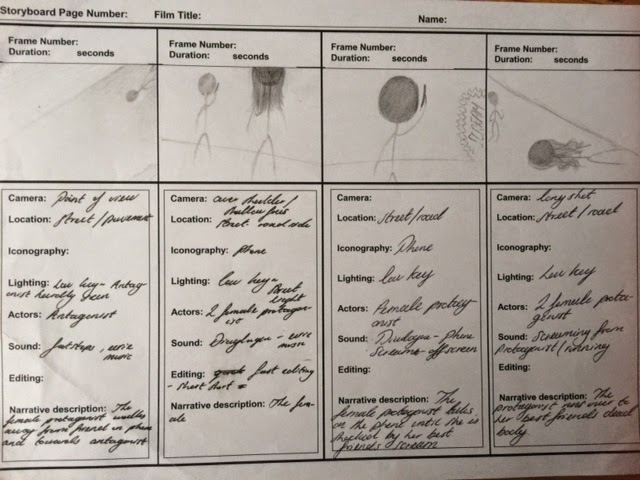
Individual Story board

Individual Storyboard- Miss Miller

Story boards are an excellent way to visually identify the specific key points within a piece, such as our thriller film. Each individual section provides an in depth description of each element of mise-en-scene, whether that be, sound, cinematography, iconography, costumes etc. In turn, this provides an extremely good plan to refer back to during myself and my group's filming process.
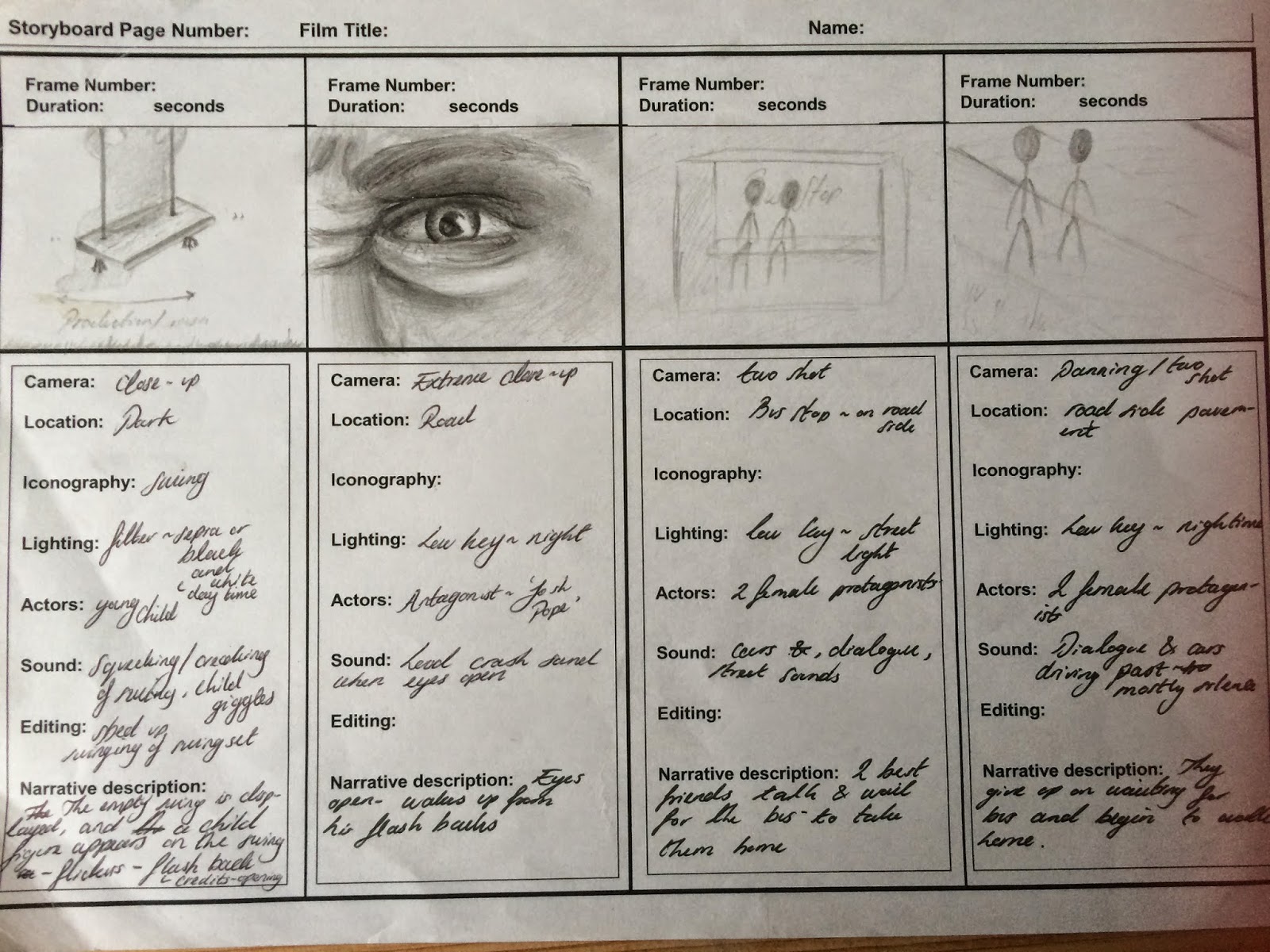
Frames 1-4

Our thriller film commences with the only scene not filmed with a theme of low key lighting, although conveyed through the use of a black and white filter. Beginning the film in black an white makes the audience question whether the time of the film is set in a time long before the present day or it is unknown. As the audience cant immediately identify the time period they are left with a slight tension, as they they fear the unknown. The scene depicts  a vacant swing, moving at a erratic, unnatural rate, suddenly being sat on by the small figure of a saddened young boy. The swing scene later becomes distinguishable as flash back of the antagonist and is dramatically cut short as the antagonist awakes and opens his eyes, shot through an extreme close up. The next two boxes depict the two female protagonists and their struggles they face immediately on their journey home from being out for the night. The introduction of the protagonists in a vulnerable state alert to the audience that they are in a dangerous position, especially as the scene is set at night time. The main aim for 1-4 of my story board is to create a variety of shots in a small space of time providing brief context, as well as presenting a sense of confusion within the audience. The beginning also presents a highly conventional thriller film element, the use of black and white, this is due to its clear connotations of a distinct division of two sides, in most cases within a thriller and this film, good and evil. 


Frames 5-8
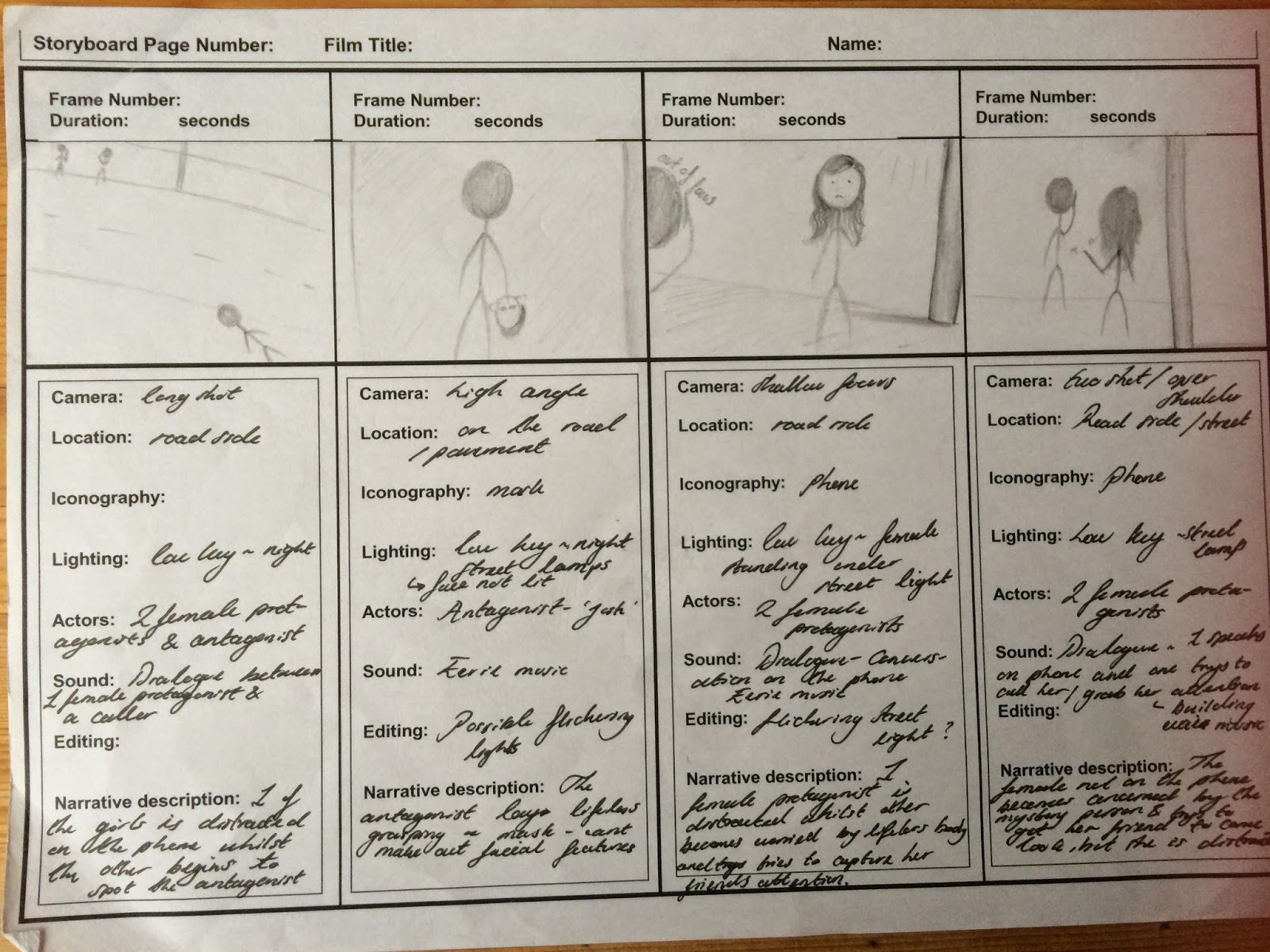
Frame 5 shown, in the image displayed to the right, depicts a panning shot of the protagonist walking in a drunken manner down the road whilst the antagonist is subtly presented. A subtle influence of the antagonist will inform the audience that he has an importance to the narrative without revealing all, providing suspense as the viewer waits to find out what purpose they serve. A very brief  high angle of the antagonist laying lifeless in the road will tease the viewer further with the antagonist's presence. 7-8 then go on to present how one of the protagonists have noticed the body and struggle to grasp her friends attention, as she talks on the phone. The lack of attention the protagonist is receiving from her friend presents the theme of separation and increases her vulnerability as she is left by herself, with the strong possibility that she will walk and investigate the mysterious body alone. The suggested tension within amongst the audience will heighten as they anticipate what will happen when she investigates the body alone. The aim of 5-8 is to provide the location and setting for the viewer, as well as displaying the prevalent theme of isolation through the protagonists and the antagonist's body. As well as this, it aims to introduce the foreboding of a danger and evil inflicted upon the protagonists


Frames 9-12
In the frames 9-12, displayed in the image to the left, it shows how the protagonist not on the phone walks away from her friend to analyse the body laying in the road. After the character walks away the audience will only be able to see the character taking through the phone, the conversation will be empty and meaningless to the narrative so the viewer is not distracted by this, solely focused upon what the other protagonist is doing and the reasons why they cannot see her actions. This is immediately followed by the off screen scream and provokes terror in the audience as they soon discover the dead body of the protagonist. I chosen to not include the antagonist in any of these frame to enhance the sense of mystery and confusion for the viewer, as they decipher whether the male character is in fact the murderer. The overall aim of these frames is to further elongate the exit of one of the female protagonists, while introducing her dead body in a dramatically sudden way, thus conveying the conventional viewer responses of surprise and complete shock.

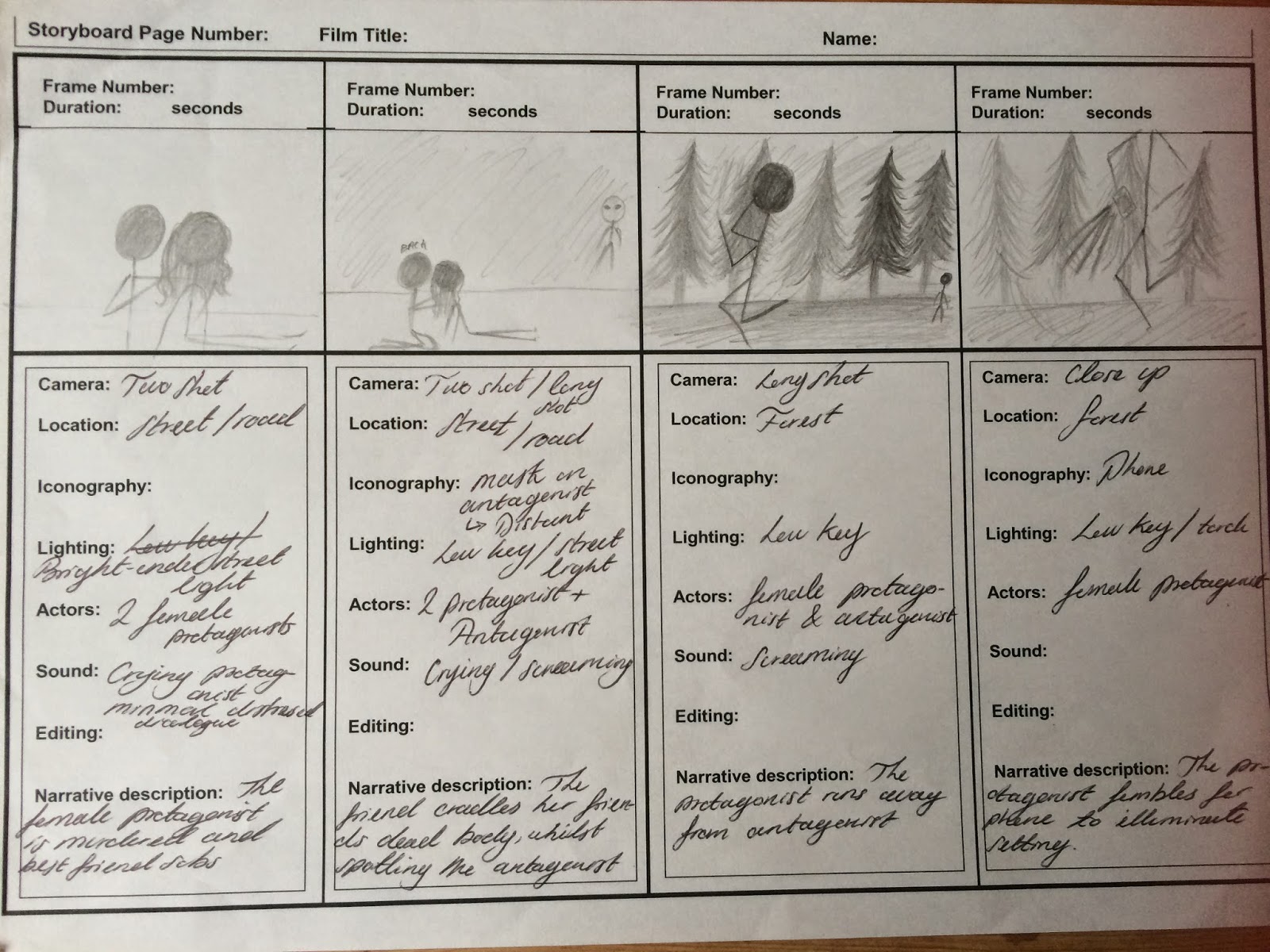
Frames 13-16
The image displayed to the right presents frames 13-16 and the emotion pain inflicted upon the protagonist as she finds her best friend's dead body limp and lifeless, except from when the protagonist abruptly coughs out blood. The antagonist is then suddenly introduced into the scene and confirms to the audience that he is the killer through the severe distress and panic the protagonist offers in response to his presence. The protagonist is then seen desperately running through a forest setting, attempting to loose the antagonist, however, because the setting is so dark, she is forced to switch on her phone torch, making it very easy for the antagonist to locate the character in the depths of the forest. As frame 16 is presented to the audience they are sure to feel a vast amount of built tension and fear for the protagonist, especially as they have already witnessed what the antagonist is supposedly capable of, making the protagonist extremely vulnerable to his intelligent precision and evil mind set. The jerky style of handheld shot, presented when the protagonist is running from the antagonist, heightens tension created by placing the audience in the characters position, providing the illusion they are experiencing all the frantic fear of the character is going currently going through. This camera shot will be paired with diegetic sounds of the protagonist's heavy breathing, as she runs away from her suspected murderer. The heavy breathing empathizes the realism of the scene, meaning although the situation is very extreme, the audience can still relate with it, causing them to be tense, as they have built a relationship with the character, through the point of view shot, and related with the scene. The aim  of these frames are to provoke a sudden burst of panic and fear within the audience to mirror what the protagonist is experiencing emotionally, providing an further insight into the mind of the character. This in turn will build a stronger relationship between the audience and the protagonist and provoke an emotionally devoted reaction from the audience during final scenes, making them gripped and suspenseful of what is to happen next. 


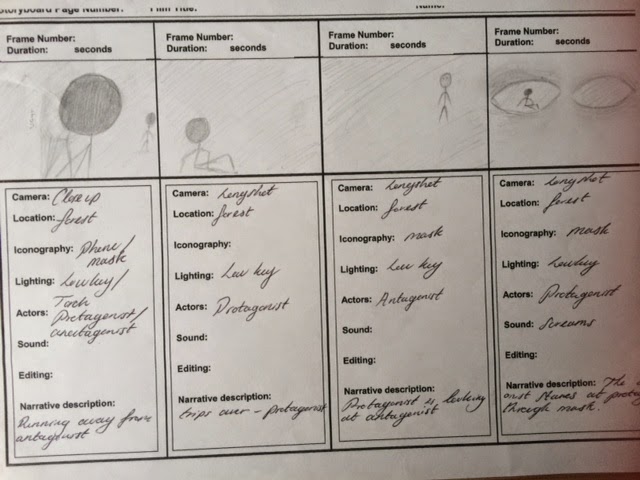
Frames 17-20
Frames 17-20 present the final scene of our thriller film. The protagonist is still featured through a point of view shot, with her torch light illuminating the image of her distressed facial expressions. The torch light cast eerie, ghostly shadows upon her face, thus intensifying the tension and fear the viewer is experiencing. As seconds pass and the image of the antagonist becomes a little unfamiliar for the audience, the protagonist trips whilst running through the forest. This immediately increases the protagonist's vulnerability as she may be wounded, as well as not having a logical though process, as she is riddled with terror. Just as the viewer becomes extremely worried for the protagonist, although mildly hopeful as they can not see the antagonist, the antagonist is shown in the distance of a long shot. The long shot provides a very vague but distinguishable image of the antagonist, casting him in the shadow of the forest. The dark shadows make it hard for the audience to view the antagonist and subsequently present the theme of hidden identity. As well as this, the sustained low key lighting, especially exaggerated during this frame, displays connotations of a prevalent evil presence (i.e the antagonist) and a sinister foreshadowing. The final frame is a point of view shot from the antagonist staring at the protagonist as she is paralyzed on the ground with fear. The mild obstruction to the camera lens by the eye hole of the antagonists mask, helps to frame the protagonists character, creating an intense focus upon her, as that is all the audience can see. Also, the clear presence of the mask emphasizes to the viewer that it is in fact the same character, as the one earlier seen laying in the road and perusing the protagonist. A terrifyingly horrific scream from the protagonist works to achieve many things. For example, as the audience are placed in the antagonists point of view they are left feeling some what guilty as they view the female character project a shrill cry as she is in serious danger. The scream also presents a memorable ending as this sound is so high pitched a loud it will lingure in the mind of the audience for a few seconds after the film is ended and has faded to black. This in turn provokes a moving response from the viewer as the protagonists agony refuses to leave them, even when the film is finished. A fade to black I felt was an efficient way to end the film because, it does not remove any attention from the final frame due to its swift transitional ability. In addition the quick and progressive darkness mirrors what the viewer is experiencing, as they are left abruptly in the dark, not knowing what will happen next. 

In my personal opinion, I feel as though my individual story board works well, as it is simplistic yet extremely detailed. I have analysed each frame and thought hard about each element of mise-en-scene and how each of these elements, whether is be sound or lighting, create an suitable and convention viewing for an audience. As well as this, I believe there is a balance of cinematography, sound and editing within the story board, making it very easy to create a detail image of the scene, before we have even filmed it. Although it appears seemingly balanced I feel as though I struggled whilst filling in the editing element of each frame, this is predominantly down to my lack of knowledge and experience of editing thus far. Furthermore, when making improvement to my storyboard I would be inclined to add more frames, as although I managed to include mostly all of the action, there were small frames such as, when the protagonist coughs up blood, that I failed to include, as I attempted to compact the film into the agreed number of 20 frames. 


My next aim is join with my group, and share a discussion about each of our individual story boards and the advantages and disadvantages of each one. We will then simply hand pick the advantages from each one, and work together to create a group story board. When creating my own storyboard I made sure that I included element we had already agreed upon. For example, the young boy on the swing during the flash back and the extreme close up of the eye. However, I was a little unsure of their thoughts and feelings towards the chase scene and how the protagonist would be clearly seen by the audience. I am therefore excited to see the variety of chase scenes each of our group have created, and how I can adapt my original perception of the ending, to suit the views of my group members. 

To conclude, planning my individual storyboard allowed be to branch away from the support of my group and explore my own personal views of our thriller film narrative and artistic direction. It allowed me to analyse what the advantages of my storyboard, as well as the disadvantages, along with how I could improve upon it. Planning also helped me create a greater understanding of our film and the possible challenges we had not first considered, such as the lack of lighting within the dark forest scene. This type of visual aid, although isn't the final group storyboard, still allows me to be more confident during filming, as I can refer back to each frame, and understand what we need to film and capture next, in order to create our idealistic thriller piece. This individual work has also highlighted to me the importance of communication within our group, as we will later come together to discuss each of our ideas, and work together to create something we are all proud of. 


Friday, 5 December 2014

Opening Sequence Narration

Opening Sequence Narration

My thriller film begins as a flash back in a park with a mid shot of a swing set, whilst the credits are appearing over the top of the image. The film will be presented through the use of a black and white filter, paired with a bright lighting state, it conveys the swing set spontaneously moving on its own, dramatically differing in speed whilst moving until the figure of a young boy suddenly appears to be sitting on the swing. The young boy will still be presented through a sustained mid shot whilst he slowly rocks on the swing and the audience will hear eerie music within the background of the action. A sudden jump cut will connect the next high angle camera shot, framing the antagonists face whilst he lay lifeless in the middle of a road. Conventional street sounds, such as driving vehicles, traffic lights at crossings and distant voices, emphasizes the typical street location. A low key lighting is prevalent due to the scene being set in the midst of the night. Sharply a jump cut draws the audience's attention away from the antagonist and to a two shot of the protagonist's, impatiently waiting at a brightly lit bus stop. 

The protagonist's are engaged in a conversation and discuss their plans to walk home, instead of waiting for the bus to arrive. Whilst they are conversing the camera will switch to a long shot of the antagonist laying in the road, displaying to the viewer what the antagonist would look like out of the corner of the protagonist's eyes. Whilst the camera shots presents the lifeless body in the road, dialogue between the protagonist continues quietly in the background and they soon notice the body in the background, just like the audience. One of the protagonists notices the body and tries to grab her friends attention, however, her friend is speaking on the phone and can not focus on what her friend is saying to her. The camera angle changes a lot within these few moments; firstly to an over the shoulder shot for this, so the audience can easily see the protagonist on the phone, as well as, putting themselves in the position of the protagonist. The camera will then changed to a long shot, showing one of the protagonists looking towards the body that is compete focus. The camera will then revert back to a basic two shot, displaying both protagonists. The protagonist that has noticed the body then make the decision to walk over to the body laying in the road. A close up of the protagonist on the phone will be displayed on screen, so the character walking over to the antagonists body will not be shown at all. At the point in the film the protagonist on the phone would have walked a little away from the bus stop, therefore the bright light produced by the bus stop will not be illuminating the scene, only the dimmer street lights. Just as the protagonist in speaking on the phone a jump cut is used and switched dramatically to an extreme close up of the antagonists eyes suddenly opening; paired with a loud crash of music the opening of the antagonist eyes will be only a duration of a few seconds, but extremely powerful. Once the the antagonist has opened his eyes the protagonist talking on phone in presented through the use of a close up. This is so that nothing but the protagonist is shown on screen.

After a few seconds of dialogue with the caller an off screen scream will be heard by the protagonist. The camera will focus on the image of a protagonist's dead body from a long shot in her perspective on the ground, presenting the other friend once on the phone, running over to the dead body of her best friends dead body. As she reaches the body, clearly distressed, a two shot displays the character's limp lifeless body in her arms. As she she questions her friends well being the protagonist coughs up blood (through the use of blood capsules). In a panicked terror the protagonist is showing through a panning shot, fleeting from the scene of her best friends murder. The light begins to get progressively darker at this point due to the time passing, pressing the action further into the night, but also because the protagonist is running from civilization, into a forest area.
The forest and surrounding street does not use any street lights pf any kind at this point. We are lead to believe the protagonist runs into the forest because it is her quickest way home and in the panic of the situation, she has opted not for the safest, most public route, but the quickest 'escape'. Due to the complete darkness of the forest, the protagonist fumbles for her phone and switched the torch on. A handheld close up convey they characters panic and also allows the torch to eerily shadow upon her face. Sounds of the protagonist heavy breathing, footsteps and distressed noises will be heard but that is all. As she travels deeper into the woods the antagonist intercepts her path; through the use of a point of view from the protagonist, or a long shot the antagonist will be presented, standing at the bottom of the foot path, in the way of the female character.

To end our thriller opening the protagonist is filmed the a point of view from the antagonist, with a little of the mask obstructing the camera lens, and focusing upon the final crescendo of emotion from the protagonist. A lingering sound will be used in the conclusion, a mixture between the shrill off screen scream of the protagonist and a non-diegetic crash of miscellaneous dramatic sound effects. Finally, a fade to black will be used to end the scene and create an ominous tension as the action is left on a cliff hanger and the colour black presents connotations of death, subsequently presenting a foreboding of how the scene continues once the film is finished.